SaaS solution
A Dual-Sided Voice & Text Medical Platform

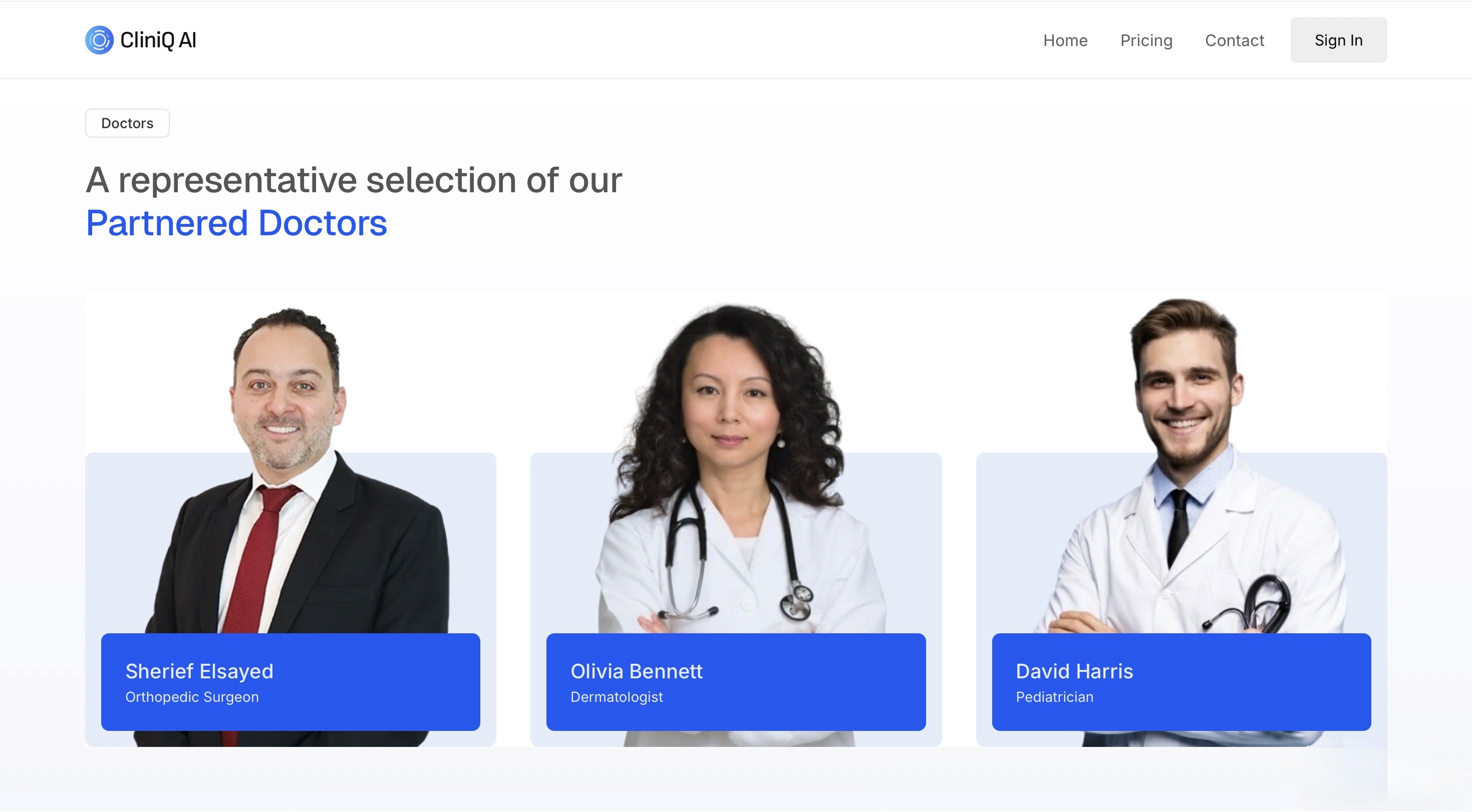
We partnered with CliniQ, a forward-thinking healthcare startup to build an advanced, AI-powered Medical AI Assistant from the ground up. The vision was to create a dual-sided platform that modernizes patient engagement and clinical workflows. For patients, the goal was to provide seamless, voice and chat-based preliminary triage and specialist referrals. For doctors, the objective was to build an intelligent clinical assistant capable of recording in-person consultations, filtering out unrelated conversation, and generating structured diagnostic reports. The project aimed to deliver a secure, monetisable, and HIPAA-aligned digital ecosystem that enhances the patient experience while drastically reducing administrative burden for healthcare providers.

Our approach
Our approach began with a thorough discovery phase to define core use cases, finalize the Large Language Model (LLM) integration strategy, and map out the user journeys for both patients and providers.
We moved quickly into a design and prototyping phase, creating wireframes and UX/UI interfaces tailored to the distinct needs of each user group.
Development followed a strict 10-week agile methodology, working in focused sprints to build the AI agents, integrate Vapi for real-time voice, and develop the consultation summarisation engine.
Security and compliance were treated as first-class citizens from day one, with robust data encryption, access controls, and rigorous QA testing to ensure alignment with HIPAA/GDPR and PCI DSS standards before the final launch and monitoring phase.
The challenge
CliniQ faced several critical challenges in bringing this complex healthcare AI product to life. Building a dual-sided platform required orchestrating two vastly different user experiences, a simple, empathetic triage tool for patients and a data-dense, automated dashboard for doctors within a single, cohesive ecosystem. Ensuring the reliability of the LLM to provide accurate, safe preliminary diagnoses without hallucinating or overstepping into direct clinical treatment was a major technical hurdle. Furthermore, integrating real-time voice AI with low latency was essential, as any delay would immediately erode patient trust. Finally, the entire architecture had to navigate strict data privacy and payment security standards (HIPAA/GDPR and PCI DSS) from the ground up, a regulatory process that often bottlenecks early-stage health tech development.
The solution
To solve these issues, we engineered a robust, scalable solution by assembling a best-in-class tech stack and implementing strict operational guardrails.
We leveraged OpenAI’s LLM paired with strict prompt engineering and curated knowledge bases to ensure safe, accurate patient assessments, backed by Airtable for secure, structured, and HIPAA-aligned data storage.
We utilised Make.com to seamlessly connect the patient-facing and doctor-facing workflows, ensuring data flowed securely between the two distinct experiences. For frictionless interaction, we integrated Voiceflow and Vapi to deliver low-latency, natural voice and chat capabilities.
Finally, we embedded Stripe to enable a dual-revenue monetisation model supporting both doctor subscriptions and patient transactional billing while maintaining strict PCI DSS compliance, resulting in a fully deployable, market-ready AI platform.
Measurable results
12 Weeks
Concept to product
AI-Powered
Diagnostic support
Voice + Text
Interaction modes
Working with the Pyxis team was an exceptional experience. They were highly proactive, incredibly responsive, and meticulously ensured that every complex detail of our AI platform was executed flawlessly from start to finish.

Dr Sherief Elsayed,
Founder of CliniQ